
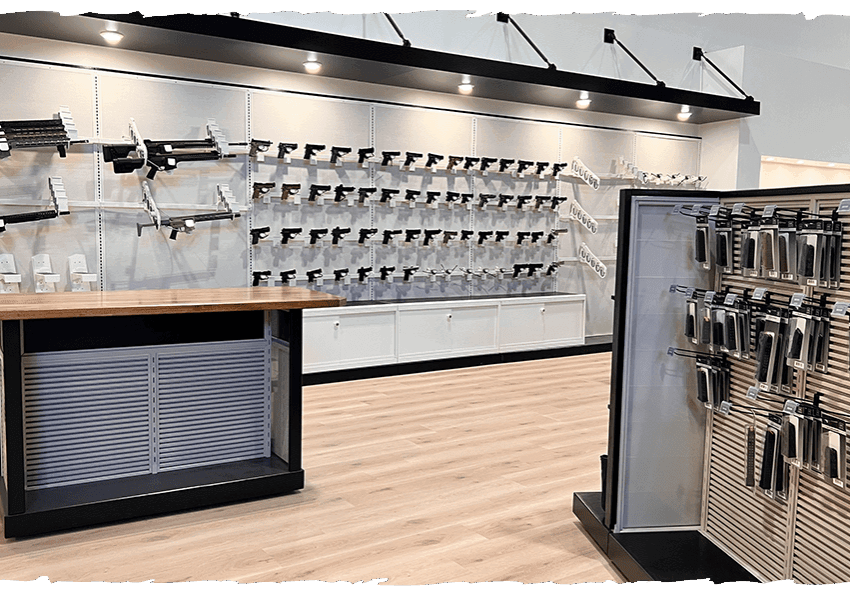
If you’re a licensed firearm retailer, state inspections are part of doing business. Most shop owners focus on their bound books and 4473s, and those things matter. But inspectors also evaluate how you store and secure your inventory, and that’s where display systems become a compliance issue, not just a merchandising one.
Here’s what to know before your next inspection.
What Inspectors Look At
Beyond paperwork, inspectors assess whether your physical security is adequate for your location and inventory. That means looking at how firearms are secured during business hours, whether overnight security is sufficient, and whether your inventory is organized enough to support an accurate count.
Disorganized or hard-to-access displays create problems fast. If an inspector can’t quickly verify your inventory against your records, discrepancies show up, even when nothing is actually missing. That requires documentation, follow-up, and explanations you’d rather not be giving.
Cable systems are another common issue. Running a cable through a trigger guard looks like security, but in many states it doesn’t meet the standard for “adequate” physical security, especially in high-traffic or high-crime areas. State requirements vary, and what passes in one jurisdiction may not in another.
A Quick Self-Assessment
Before your next inspection, ask yourself:
- Are firearms secured 24/7 without requiring nightly vault transfers?
- Can your locking mechanisms resist a quick tampering attempt?
- Can serial numbers be read without removing firearms from displays?
- Is inventory organized well enough for a fast, accurate count?
- Do your displays give cameras clear sight lines for surveillance?
If you answered no to more than one or two of these, your display setup may be creating compliance exposure you haven’t accounted for.
How the Right Display System Helps
Good display systems solve compliance and sales problems at the same time. Gun Warden Vertical Sliders and Horizontal Locking Arms keep long guns organized, clearly visible, and serial-number-readable without removing firearms from the display. That makes physical inventory fast and accurate. Security Showcase units provide overnight security for handguns and accessories with shatter-resistant glass and tested locking protection, so nothing needs to move to a vault at closing time.
The Pistol Warden offers the same one-key locking system for handguns on the floor, keeping them secure and displayed professionally without the back-and-forth of a traditional glass case. One key operates the entire system, which means staff spend less time managing access and more time with customers.
That matters for sales too. When customers can get close to inventory, read price tags, and see the full profile of a firearm without anything in the way, they engage differently than they do peering through smudged glass. And because the rubber-coated rests in Gun Warden systems protect firearms during display, you’re not absorbing scratches and dings from repeated handling the way you would with traditional systems.
Eliminating nightly vault transfers alone can save 30 to 60 minutes of staff time per day. At $15/hour, that’s roughly $2,700 to $5,500 back per year, before you count the reduction in handling damage.
The States Raising the Bar
California, Colorado, Washington, and Illinois have all implemented enhanced firearm dealer security requirements beyond baseline licensing. Other states are moving in the same direction. Retailers who build their security infrastructure to meet the strictest current standards are already positioned for whatever comes next.
Ready to take a closer look at your setup? Contact Quality Wood & Metal Designs to learn how Gun Warden systems support compliance and strengthen your operation. Email info@qualitywooddesigns.com.